
Mood is often a more reliable filter than genre or score when the evening is already underway. The practical question is not which games are highly regarded. It is which games match the residual energy and emotional temperature you actually have tonight.
I have wasted evenings by choosing titles that looked perfect on paper but felt wrong in the moment. A highly rated game can still demand more concentration than you want to give. A familiar favorite can feel too slow when you need stimulation. A complicated RPG can be perfectly good and still be the wrong choice when your brain has already had enough decisions for the day.
The games that work best are often the ones that meet the mood instead of fighting it.
Low friction, high payoff still applies. Mood simply determines which shape of payoff feels available.
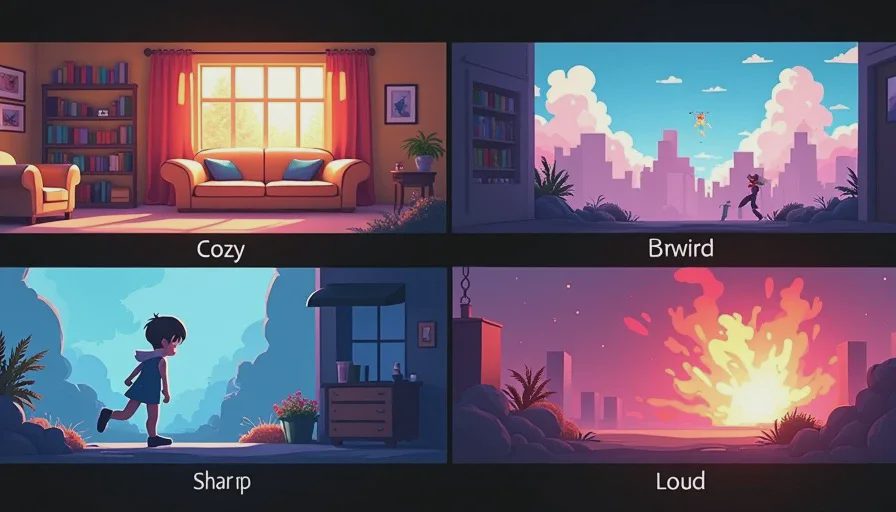
This piece offers a practical four-quadrant filter—Cozy, Sharp, Weird, Loud—and maps common residual-energy states onto them so the decision can be made in under a minute.
Why Mood Beats Most Other Filters
Genre labels are useful, but they are broad.
A puzzle game can be relaxing or mentally demanding. An RPG can provide quiet exploration or constant combat. Even two games from the same genre can create completely different emotional demands.
Critical scores have a similar limitation. A 95-rated game tells you that many people considered it excellent. It does not tell you whether you want that particular experience at 9:30 on a Tuesday night after a long day.
Backlog size creates another problem. When there are dozens of unplayed games available, choosing based on quality alone can create another decision task.
Mood is different.
It is information you already have.
You usually know whether you want to relax, concentrate, explore something unusual, or burn off some energy. Starting there reduces the chance that the session will feel like another obligation.
The Four Practical Moods
The four categories are deliberately simple:
Cozy — low cognitive demand, restorative tone, visible gentle progress
Sharp — readable challenge, clear feedback, precision, or mastery
Weird — unexpected tone, surreal ideas, unusual systems, or curiosity
Loud — high energy, immediate action, chaotic or intense feedback
These are not rigid genres.
They are decision shortcuts.
A game can occupy more than one quadrant depending on the moment. A familiar action game might be Loud when you want stimulation but Sharp when you are specifically looking for mastery.
The purpose is not to classify your entire library perfectly.
It is to make tonight's decision easier.
Matching Mood to Residual Energy
The first step is to identify how much attention you have left.
Do not answer based on how much time remains before bed. A person can have two free hours and only enough mental energy for a simple game.
Residual energy is about attention, not the clock.
Residual Energy | More Likely Mood Fit | What the Session Should Feel Like |
|---|---|---|
Very limited | Cozy | Gentle progress, almost no new systems |
Low-moderate | Cozy or light Sharp | Clear agency without high stakes |
Moderate, want focus | Sharp | Precision, readable challenge, mastery |
Want novelty | Weird | Curiosity, unexpected tone or systems |
Want release | Loud | Immediate action, high feedback, energy |
The table is a starting filter rather than a ranking.
If you are exhausted but restless, Cozy may be technically appropriate but emotionally wrong. You might actually need something Loud that clears your head through immediate action.
Likewise, a calm evening with plenty of attention may be a good opportunity for Sharp, even if the game requires more concentration than you would normally choose.
The emotional need matters alongside the energy level.

Cozy: When You Want the Evening to Get Quieter
Cozy is the natural choice when the day has already taken enough from you.
The ideal session does not require extensive preparation or constant decision-making. You want to see something happen, make modest progress, and gradually settle into the rhythm.
The payoff is not necessarily excitement.
It is relief.
Cozy games work particularly well when you want to play but do not want gaming itself to become another demanding activity.
The key test is simple:
Does this game make the evening feel easier?
If yes, it is probably a good fit.
Sharp: When You Still Want to Think
Sometimes residual energy is limited but your brain is not ready to switch off.
That is where Sharp fits.
You want clear objectives, responsive controls, readable feedback, and the satisfaction of getting something right.
This can be a puzzle, strategy challenge, precision platformer, or another game where improvement is immediately understandable.
The important distinction is that Sharp should feel focused, not administratively complicated.
You want to think about the problem in front of you, not spend twenty minutes remembering where everything is in a sprawling system.
Weird: When You Want Something Different
Weird is useful when the problem is not low energy but sameness.
Maybe you have played the same types of games for weeks. Maybe nothing familiar sounds appealing. Or perhaps you want something that creates curiosity without demanding a major commitment.
Weird games provide a different kind of payoff.
You might not know exactly what the next ten minutes will look like. That uncertainty is the attraction.
This category is particularly useful for breaking backlog paralysis because it changes the question from:
"Which good game should I play?"
to:
"What sounds interesting right now?"
That is often an easier question to answer.
Loud: When You Need to Release Energy
Loud is the opposite of Cozy.
This is the quadrant for evenings when you are mentally tired but still physically or emotionally restless.
You want immediate feedback, movement, action, noise, or controlled chaos.
The advantage is that Loud games usually do not require you to manufacture motivation. They provide stimulation immediately.
A short session can therefore feel surprisingly effective.
You start, act, react, and finish.
There is little time spent wondering whether the game will eventually become interesting.
The danger is choosing Loud when you are actually exhausted. If the stimulation feels irritating rather than energizing after ten minutes, the match is wrong.
How to Use the Filter Tonight
The entire process should take less than a minute.
1. Name Your Residual Energy
Be honest.
Are you exhausted, somewhat tired, reasonably focused, or actively looking for stimulation?
2. Name What You Want Emotionally
Do you want to rest, focus, explore, or release energy?
That gives you the likely quadrant:
Rest → Cozy
Focus → Sharp
Explore → Weird
Release → Loud
3. Pick the Lowest-Friction Match
Do not search your entire library.
Look for the easiest game you already know fits that quadrant.
If choosing takes ten minutes, the filter has defeated its own purpose.
4. Give It Twenty to Thirty Minutes
The first session does not need to become a commitment.
Give the game enough time to establish its rhythm.
If the mood match feels wrong, stop.
You do not need to finish the session just because you started it.
What If No Game Fits?
Sometimes the answer is not another game.
You may be too tired for Cozy, too restless for Sharp, uninterested in Weird, and too drained for Loud.
That is useful information.
A night without gaming is not a failed gaming night.
The purpose of the filter is to protect free time, not to force a game into every available window.
If nothing fits, stopping before you start may actually be the lowest-friction, highest-payoff decision available.
Closing the Loop
Mood is one of the most useful tools busy adults have for deciding what is worth opening tonight.
Cozy, Sharp, Weird, and Loud are simply names for four different emotional and energetic temperatures.
The important thing is not to choose the objectively best game.
Choose the game that asks for the kind of attention you are actually willing to give.
Match the game to the mood you have rather than the mood you think you should have.
Keep the friction low.
Protect the payoff.
And if the right choice turns out to be nothing at all, that is still a valid result.
Low friction, high payoff remains the practical standard across every mood.
No comments yet — grab the first one.