
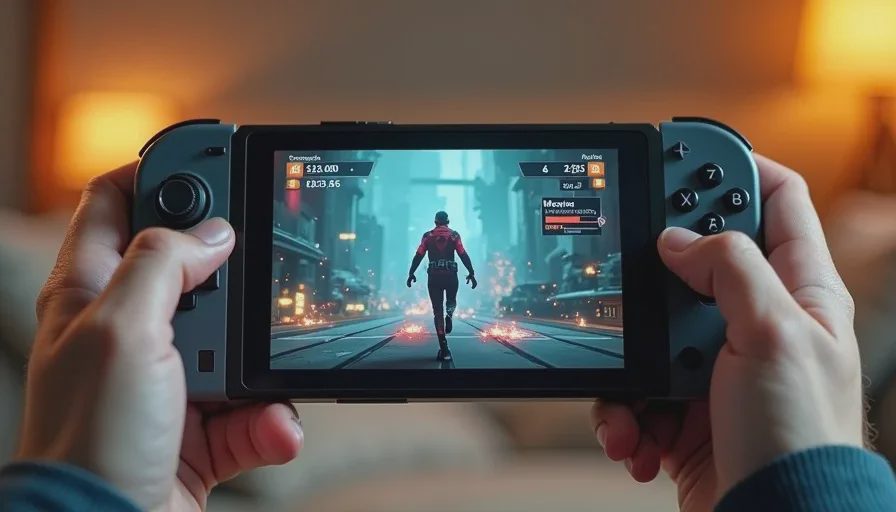
The Steam Deck changed the shape of short evening sessions for many adults. The practical question is no longer whether handheld play is viable. It is which games on the Deck actually support nightly drop-in play—sessions that start quickly, deliver a complete unit of enjoyment, and stop without friction.
I have tested dozens of titles in exactly this context: twenty to sixty minutes after the rest of the day is finished. The ones that survive share a structural trait: they treat the short session as valid rather than as a fragment of a larger obligation.
That distinction matters.
A game can run perfectly on the Deck and still be a poor nightly companion. If it requires ten minutes of setup, remembering several interconnected systems, or reaching a distant checkpoint before you can safely stop, the handheld form factor cannot solve the underlying problem.
The most useful filter remains simple:
Low friction, high payoff.
This piece focuses on what makes a game Deck-native for nightly use, which structural patterns work best, and how to match them to the amount of residual energy you actually have.
What Nightly Drop-In Actually Requires on the Deck
A game can perform well on the Deck and still fail as a nightly game.
The important distinction is whether its design accepts interruption.
The best drop-in games behave as though a twenty-minute session is a legitimate way to play. They do not constantly remind you that you are only seeing a small piece of a much larger experience.
Core Traits for Drop-In Play
Cold boot or resume to playable state in under sixty seconds
Immediate agency after the title screen
Clean, frequent, or automatic saving
Readable UI at handheld scale
Session units that feel complete inside 20–60 minutes
Low cognitive overhead when residual focus is limited
Little penalty for stopping earlier than planned
The first requirement is especially important.
If you have forty minutes available, spending five or ten minutes navigating menus, rebuilding a loadout, or waiting through repeated sequences changes the value of the entire session.
The same applies to cognitive overhead. A game may only take a few minutes to launch but still demand considerable mental preparation before it becomes enjoyable.
When these traits are present, the Deck becomes a reliable evening tool. When they are absent, the device itself cannot compensate.
Structural Patterns That Work on the Deck
Different genres can support short sessions, but several design patterns consistently perform well.
Short, Readable Runs
Run-based games are natural candidates when individual cycles land inside roughly 15–30 minutes.
The advantage is not simply that the runs are short. The run itself becomes a complete unit.
You start with a clear state, make decisions, see your character or build develop, and eventually reach an outcome. When the run ends, you can stop without feeling that you abandoned something important.
This works particularly well when the decision space remains readable on a small screen.
Failure should also be informative. If a failed run immediately suggests what you could try differently next time, the game creates a natural reason to return without creating pressure.
Light Systemic Loops
Management, building, farming, and arrangement games can also work well when they allow visible progress in short bursts.
The important factor is not whether the system has depth. It is whether that depth requires you to remember a large mental model between sessions.
A good nightly game lets you make a small decision, complete a task, improve something, and stop.
The session may only move the game forward a little, but the progress is still visible.
Contained Narrative or Atmospheric Chunks
Story and exploration games can work when they provide natural stopping points.
A chapter, area, sequence, or meaningful conversation can function as a complete evening unit.
This is different from a game where forty minutes of play feels like preparation for something that happens later.
If you can spend forty-five minutes in a game and feel that you experienced a meaningful piece of its world, it can pass the drop-in test even if the overall campaign is much longer.
Immediate Action or Precision Challenge
Action games can support short sessions when their core verb becomes available almost immediately and checkpoints are generous.
You enter an encounter, complete several challenges, and stop.
The less preparation surrounding that action, the better the fit for a limited evening.
Matching by Residual Energy
The best game is not necessarily the best game in your library.
It is the game that matches the amount and type of attention you have left.
Residual Energy | Stronger Pattern | What the Session Should Deliver |
|---|---|---|
Very limited | Light systemic or atmospheric | Gentle progress, almost no new learning |
Low-moderate | Short readable runs | Complete cycle + visible growth |
Moderate | Immediate action or precision | Several finished challenges |
Want story texture | Contained narrative chunks | One finished emotional or spatial unit |
Want sharp focus | Action / precision | Clear challenge and immediate feedback |
This is a starting filter rather than a ranking.
Someone with low energy may still want a demanding game if they are specifically looking for focus. Likewise, someone with plenty of time may prefer something simple because they do not want another complicated system to manage.
The important question is not only:
"How much time do I have?"
It is also:
"How much attention do I want to spend?"
Common Deck Nightly Friction Points
Several problems repeatedly make otherwise good games poor choices for short sessions:
Long unskippable sequences after resume
UI that becomes difficult to read at handheld scale
Systems that punish gaps between sessions
Titles whose minimum viable session exceeds the available window
Performance settings that require constant tweaking
Long travel sections before meaningful gameplay begins
Save systems that make stopping inconvenient
None of these automatically makes a game bad.
They simply make it less suitable for nightly drop-in play.
A large RPG may be excellent but better suited to a two-hour evening. A mechanically demanding action game may be perfect when you want focused challenge but frustrating when you are mentally exhausted.
The Deck does not require every game to fit every evening.
It simply makes it easier to choose according to the evening you actually have.
Long Games Can Still Pass the Test
Not every nightly game needs to be short overall.
A game can take fifty hours to finish while still offering meaningful thirty-minute sessions. Total runtime and minimum session commitment are different things.
A long RPG with frequent checkpoints may work surprisingly well, while a shorter game with long uninterrupted sequences may feel much harder to fit into a busy evening.
That is why total playtime is not the most useful measure.
The better question is:
How much do I need to commit before tonight's session feels worthwhile?
If the answer is twenty minutes, the game may be an excellent Deck companion.
If the answer is two hours, it belongs in a different category.
The Two-Hour Energy Game Test
Some games are simply better reserved for nights when you have enough energy to settle in.
If a title repeatedly makes you think, "I should wait until I have two hours," that is useful information.
Let it wait.
Call it a two-hour energy game rather than forcing it into a twenty-minute session.
This can make the entire library easier to manage. Short-session games handle tired nights. Long-form games handle higher-capacity nights. Atmospheric games handle quiet nights. Action games handle focused nights.
The goal is not to make every game fit the same schedule.
It is to know which games fit which evenings.
Closing the Loop
Steam Deck games that support nightly drop-in play treat the short session as valid.
They start quickly, provide meaningful progress, and allow you to stop without penalty.
That might mean a 20-minute run, several completed puzzles, a small building project, a chapter of a story, or a handful of focused challenges.
The genre does not matter as much as the structure.
Match that structure to the energy you actually have.
If your focus is low, choose something with minimal learning and setup. If you want visible progress, choose short repeatable cycles. If you want story, look for contained narrative units. If you want challenge, choose something where the core action begins immediately.
And if a game repeatedly fails the drop-in test, let it wait for a higher-capacity night.
A twenty-minute session can be a complete session.
A forty-five-minute evening can be enough.
That is the real advantage of a good Steam Deck game: it does not make limited free time feel like an incomplete version of gaming.
It makes that limited time feel sufficient.
Low friction, high payoff remains the most practical filter for deciding what is worth opening tonight.
No comments yet — grab the first one.