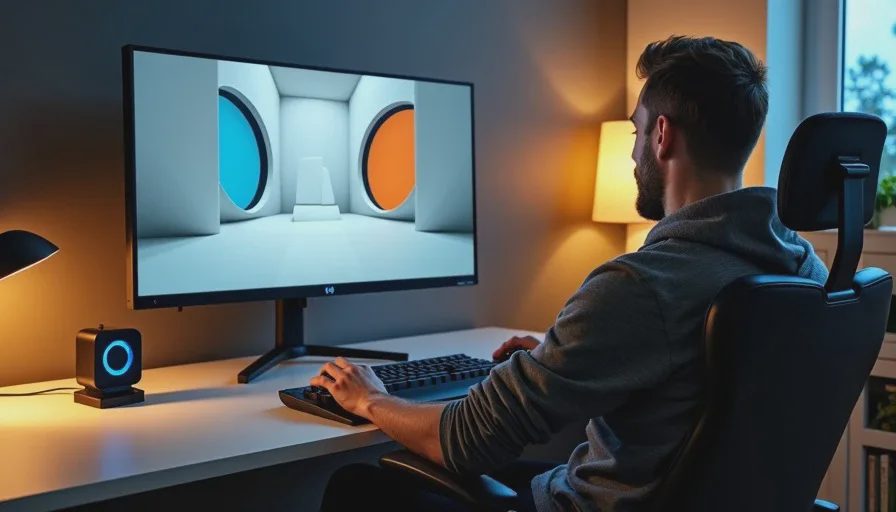
Portal 2 has spent more than a decade as the default “safe” recommendation for almost any player. The question in 2026 is whether that status still holds.
After replaying it with the same constraints most busy adults face—limited residual focus, finite evening windows, and no appetite for systems that punish interruption—the answer remains yes, with only minor caveats.
The game still delivers a complete, self-contained experience that starts cleanly, teaches through play, and ends without demanding a second weekend. Low friction, high payoff continues to describe the session shape.
That does not mean Portal 2 is immune to age. Players who have spent years with games may recognize some of its design language immediately, and its campaign is no longer a mystery to anyone familiar with modern gaming culture. But those are different questions from whether the game remains easy to recommend.
This piece examines what still works, what has aged, and how to decide whether it is the right recommendation for a specific person and night.
Why Portal 2 Remains an Unusually Safe Recommendation
Most highly regarded games carry hidden costs.
Some require long tutorials before the actual game begins. Others introduce dense systems that take several sessions to understand. Some rely on a long narrative arc that becomes difficult to follow when play is interrupted for weeks at a time.
Portal 2 avoids most of those costs.
The core verb—place portals, move through space, solve spatial problems—is introduced quickly. The game teaches its rules through interaction rather than asking the player to memorize a manual. Each new mechanic is generally presented in a context where its purpose becomes understandable through experimentation.
That makes the game unusually approachable.
You do not need previous experience with complex puzzle games. You do not need to understand an elaborate character build. You do not need to remember a large inventory of abilities.
You simply enter a chamber and figure out what the game is asking you to see.
Session Shape and Real-Life Fit
A typical evening can cover several chambers and still feel complete.
That matters more than it sounds.
A player with only an hour may not finish a major story chapter in another game. In Portal 2, however, completing several puzzles can provide a clear sense of progress without requiring a long uninterrupted block.
The game also saves cleanly between sections. There is almost no inventory or build management. Failure is informative rather than punishing. When a solution does not work, you can usually try another approach immediately.
That makes mistakes feel like part of the puzzle rather than a setback.
For busy adults, this creates a useful rhythm:
Start → experiment → solve → move forward → stop.
The session does not need to become a major event.
What Still Feels Fresh in 2026
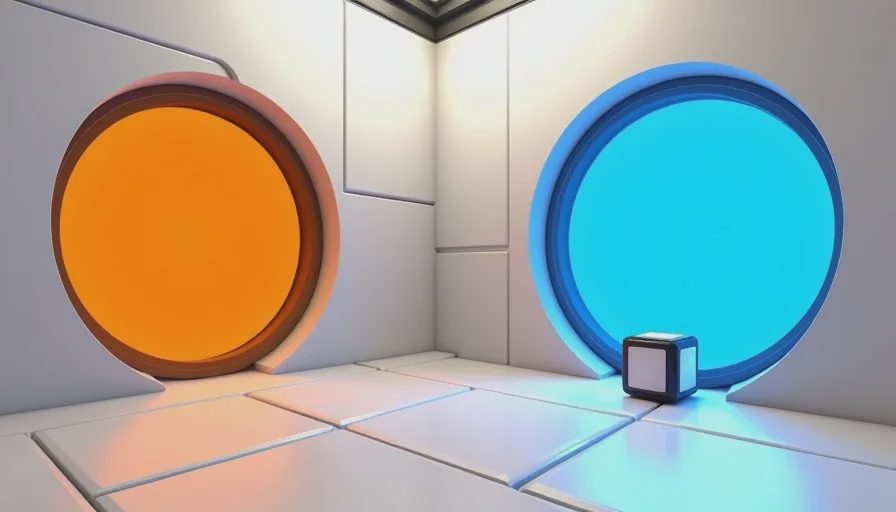
The level design remains the center of the experience.
Spatial logic that was elegant when Portal 2 released is still elegant because the underlying satisfaction does not depend on visual novelty. A chamber presents a problem, you form a mental model of the space, test an idea, and eventually understand the relationship between objects.
The best moments are often simple.
You see a surface that looks ordinary.
You notice an opening you had previously ignored.
You realize that momentum, distance, or portal placement changes the problem.
Then the solution suddenly becomes obvious.
That feeling has not become outdated.
Humor and Character
The writing also remains an important part of why the game is easy to return to.
The humor is character-driven rather than dependent entirely on contemporary references. That gives it more durability than jokes built around a specific cultural moment.
The characters provide momentum between puzzles without turning the game into a dialogue-heavy experience.
You can enjoy the writing, but you are rarely forced to stop playing for long stretches simply to absorb exposition.
That balance is important.
The game can be funny without becoming a comedy game, and it can tell a story without making the player feel as though the gameplay is merely waiting for the next cutscene.
Co-op Still Has a Different Kind of Value
The two-player co-op campaign remains one of the strongest reasons to return.
The structure is fundamentally different from simply taking turns with a single-player game.
Both players participate.
Both have useful tools.
Both need to understand what the other person is doing.
That creates natural conversation.
One player may notice a portal location while the other understands how to create the necessary momentum. Sometimes one person solves the conceptual problem while the other executes it.
The result is a shared experience where communication is part of the puzzle rather than something happening around it.
For two people with limited time, that can make an evening feel productive without becoming overly serious.
Practical Strengths for Busy Adults
Several qualities continue to make Portal 2 particularly compatible with limited evening sessions:
Extremely low start-up friction
Teaching that happens inside the puzzles themselves
Clean stopping points between chambers
Very little inventory or build management
Failure that encourages experimentation rather than punishment
Co-op that does not require a long rules explanation
A complete single-player arc that feels finished on its own
Enough variety to make short sessions feel meaningful
The important point is that these strengths work together.
A game can have short levels but still require a lot of mental preparation. Another can have simple controls but demand constant story recall.
Portal 2 keeps many of those demands low at the same time.
Player Situation | How Portal 2 Responds | Practical Note |
|---|---|---|
New to the series | Tutorial chambers teach without lectures | Safe first recommendation |
Already finished years ago | Co-op campaign or challenge content remains | Fresh shared-play option |
Limited residual focus | Chambers are relatively self-contained | Easy to stop and resume |
Want a shared experience | Co-op is symmetric and low-explanation | Conversation and play coexist |
Short evening available | Puzzles provide natural progress units | No need for a marathon session |
Want something contained | Campaign has a defined endpoint | Less backlog pressure |
The table is a quick matching tool.
Residual energy and social context will refine the decision.
Why the Game Does Not Feel Like Homework
One of Portal 2's most useful qualities is that it rarely asks the player to prepare before playing.
There is no complicated character sheet to rebuild after a long absence.
There is no collection of quests that requires twenty minutes of reading before you know what matters.
There is no need to optimize your equipment before entering the next area.
The puzzle itself is the problem.
That simplicity can be especially valuable after a long day.
If you only have an hour, you can spend most of that hour actually playing.
This is one reason the game continues to work as a recommendation even for people who have accumulated a large library of more ambitious titles.
Minor Caveats in 2026
The recommendation is not universal.
The single-player campaign is no longer a surprise for most people who follow games. Many players already know its major moments, characters, or even individual puzzles before playing.
The visual style, while still clean and readable, also no longer feels cutting-edge.
More importantly, Portal 2 is not designed around long-term progression.
Once the campaign is finished, players who primarily want endless systems, character builds, competitive mastery, or constantly changing progression may have little reason to keep returning.
The same applies to players who simply do not enjoy puzzle-solving.
A game can be approachable without being universally appealing.
Portal 2 still asks you to stop, observe, experiment, and think.
If your residual energy is too low for that kind of attention, even a simple puzzle can feel demanding.
That is not a flaw in the game.
It is a question of fit.
When Portal 2 Is the Right Night
Portal 2 makes the most sense when you want something that is:
Easy to start
Easy to understand
Interesting without being exhausting
Structured around small units of progress
Funny without requiring constant attention to dialogue
Suitable for either solo play or a shared evening
Long enough to feel substantial but contained enough to finish
It is especially useful when you do not want to commit to another enormous game.
Sometimes the best recommendation is not the game with the most content.
It is the game that makes the most of the time available.
Closing the Loop
Portal 2 remains one of the easiest great recommendations in gaming because its structure was never built around prestige or length.
It was built around clarity, humor, spatial satisfaction, and a steady rhythm of problem and solution.
Those qualities still map cleanly onto the evenings most busy adults actually have.
The game has aged.
Its visuals are familiar.
Its major surprises are no longer surprising.
Its systems are deliberately limited.
But none of those things undermine the central experience.
If you need a title that starts cleanly, teaches without lectures, gives you satisfying progress in relatively small units, and leaves both solo and co-op players with a finished feeling, Portal 2 remains worth opening.
The chambers are still elegant.
The writing still lands.
The puzzles still make you stop and think.
And the session still respects the amount of time most of us can realistically protect.
Low friction, high payoff continues to be the practical test.
No comments yet — grab the first one.